By Chris Miele, JWMS Vol. XXVI, No. 3, 2026
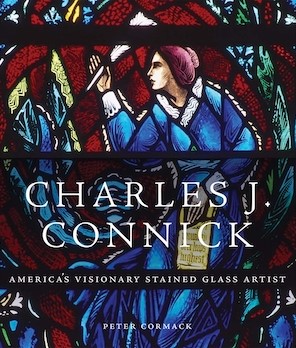
Peter Cormack, Charles J. Connick. America’s
Visionary Stained Glass Artist. New Haven and
London: Yale University Press, 2024. 376
pages, 244 K 285 mm, 297 colour & bw
illustrations. £60, $75. ISBN 978-0-300-
27232-1.
This superb book, a fitting companion to the author’s Arts and Crafts Stained Glass (2015), achieves the same high of scholarship. It too is beautifully illustrated. Page after page of colour photographs march in step with thoughtful analysis. Word and image draw the reader along across the life and art of a
remarkable man. The experience is absorbing. The author and the publisher are really to be congratulated.
How to characterise the publication? It is art history but it is also biography and it has a gently polemical object too. It also strikes this reviewer, an American, as the sort of story that Americans like to think represents the best of their country. Here is the rise of lonely individual, from poverty and obscurity
to very great heights of artistic achievement, ‘visionary’ status even. Beside all that we have full accounts of working methods and studio organisation, the business of being an artist working in large projects. A handful of major commissions get full length accounts charting their genesis and evolution and completion. The chapter devoted to Connick’s Princeton University Chapel, from the late 1920s, demonstrates why this scheme is a true masterpiece of twentieth-century art.
Like many stained-glass artists, and in fact many others working in other media, Connick came from a working-class background. He grew up in Pittsburgh, a particularly grim slice of the American industrial revolution. A slightly odd boy, Connick was ostracised by classmates. A teacher noticed he had artistic ability. That was the first piece of good luck. It led to a job as a cartoonist for the Pittsburgh Post.
After he was let go, there was another fortunate encounter. Connick just happened to bump into a founder a newly established stained-glass studio who had happened to have seen some of his work. This led to an apprenticeship in Rudy Brothers and Reich of Pittsburgh, the artist’s springboard.
This firm produced ‘art glass’ using opalescent glass, following the American masters Lafarge and Tiffany. As Cormack explains this glass ‘deployed techniques and types of glass that were fundamentally different from those developed in the Middle Ages and subsequently revived in Europe in
the early nineteenth century.’ Art glass sought to emulate the effects of painting. Its pioneers had travelled to Europe to study ancient and modern glass but they deliberately explored a different form of
expression, one that is distinctively American.
Connick might well never have deviated from that tradition were it not for the third piece of good luck. In 1909 he contrived to get an audience with none other than Ralph Adams Cram. Cram was then the leading Gothic Revival designer in the US, developing the style to a state of refinement and excellence that equalled, arguably surpassed, what had been achieved in England, an irony of sorts that requires some explanation historically.
Before thinking about the ‘why’, we go back to that fateful meeting in Boston, Connick would live and work for the rest of his life. Cram understood the importance of stained glass in his revived Gothic interiors. He had a strong preference for the English master Christopher Whall. The architect had wanted him for a large and important church in Brookline, a wealthy suburb of Boston. Whall was too busy. And so, Connick had an opportunity. He knew the sort of thing Cram wanted, so Connick showed him photographs of one of his medievalising designs from a church in Pennsylvania. How fortunate that he had had the opportunity of doing some traditionally styled, English-influenced work. Cram was so impressed he took the brave step of advising his client to employ Connick for a prestigious commission. On that back of this work, Connick set up on his own, eventually taking a large studio in Harcourt Street in the Back Bay area of the Boston. In the decades that followed the two collaborated often and it is not too much to say that Cram’s support was essential to Connick’s success at least through the late 1920s by which point his body of work and reputation gave Connick an independent platform outside Cram’s
orbit.
But now to return to what many English readers will think is a strange irony: how exactly the Gothic Revival, moulded on medieval precedents and a millennium of heritage, was only fully realised 5,000 miles away on the east coast of the USA. Cormack does not, I think, delve too deeply into this part of the story. The reasons are, however, pretty straightforward. First, we must remember that the First World War was an absolute watershed for European art and design, a terrible break in production. The trajectory of practice in the US was, however, continuous. That trajectory was fueled by the sustained economic boom that started at the end of the Civil War and lasted until 1929. The result was a plethora of architectural commissions, for commercial work (offices and factories) but also for civic buildings, schools, universities, churches, museums, town halls, not to mention apartment buildings and huge houses. The Gothic Revival in America was the favoured style for schools and universities and of course also for churches, though not, interestingly, for museums and courts. The Gothic tied the New World back to the Old
one through association, giving weight and substance to certain institutions.
There was another force at work here. Cram’s ascendency paralleled the rise of American nativism, a movement reflecting the anxiety the white Anglo-Saxon establishment felt towards extensive
immigration from southern and eastern Europe and from Mexico. In New England and the old South, organisations like the Daughters of the American Revolution, mostly descended from English families,
preserved landmarks from the Colonial and Federal periods, intending these images of early American virtue to inculcate and celebrate traditional American values. Paul Revere’s house (not so far from Connick’s Harcourt Street studio) was turned from a pizza parlour into a national shrine. The cult
of Thanksgiving, venerating the virtues of self-reliance and individualism expressed by
the Pilgrim fathers, dates from this period too.
Cram for his part tried to distance himself from he put was the ‘meticulous pedantry of
nineteenth-century Teutonism’ in his collected lectures publishes as The Substance of Gothic in 1917. Protestations to one side, Cram felt the nationalistic and racial pull of the Gothic. In the concluding lecture, he cannot help but link the purity of the style to racial purity of the ‘blood of the north’ which yielded some magical elixir that combined religious devotion, a belief in capitalism, power and vigour, and a host of chivalric values. This is not in any way to say that Connick held views that are, to many anyway, now deeply troubling (not least because there is now another nativism on the prowl). All that
explains why Connick had so many opportunities and motivated wealthy clients searching for an image of the world as it used to be. Connick’s artistic voice developed from this point through the study and appreciation of English medieval glass, which he knew from photographs and from direct experience of modern English glass purporting to be based on those precious originals (because there was a lot of English glass in American churches). In July 1910, Connick made his first visit abroad, armed with a letter of introduction from Cram to Whall in London. He was friendly and supportive. From there Connick visited the great collections of medieval glass in England (including some modern ones, notably Whall’s in Gloucester Cathedral). He moved on to France where he toured some twenty different sites in two months.
The work he produced after this pilgrimage shows the influence of that direct encounter. His glass takes on an intensity of hue and purity of colour which aims at the effect he described in a 1915 article which Cormack cites, and where Connick describes medieval glass as ‘the singing splendour of pure transparent colour suffused with light’. In that same article the artist criticised the overly rich, sophisticated use of opalescent glazing in American art glass.
This new style, purified by study of authentic originals, combines with Connick’s increasingly refined figure style, earning him the title ‘the Burne-Jones of America’ as one reviewer of his work at the Panama Pacific International Exposition, in San Francisco, put it in 1915. As Cormack observers, however, the overall character of Connick’s work and the intensity of his colours tilted it towards medieval sources and the comparison with Burne-Jones might have been a little too facile. At this point, we get a sense of Connick’s creativity, his ability to shape influences – Burne-Jones, Whall and medieval glass – into a new form of expression that gives his windows a striking, recognisable and distinctive character.
Connick’s second visit to France, in 1922, brought him even closer to his twelfth- century sources (a period Cram particularly loved). About the glass he saw in churches in Charlons-en-Champagne and Varennes (displayed at the Trocadero in Paris as it happens), Connick observed that this work demonstrated ‘whole-souled devotion to spirit rather than to form’ in their drawing ‘and complete mastery of the craft as a mode of aesthetic expression’.
This ‘spirit’ is not religious sentiment. It is feeling freed from faith and expressed through technique and materials. In this way, Connick’s approach to aesthetics comes close to the critical framework that the great art historian Meyer Shapiro imposed on his analysis of Romanesque art, and in particular through his ground-breaking, 1931 study of the sculpture at Moissac. We must remember, I think too, the contemporary enthusiasm for early medieval art was reflected in the remarkable collecting together of Romanesque painting in the Catalan National Museum in Barcelona or, getting back across the water, to the creation of the Cloisters in upper Manhattan to house the Met’s superb collection of medieval art. Beginning in 1925, opening in 1938, this Rockefeller-funded scheme spans almost exactly the period of Connick’s greatest achievement.
Cormack has got under the skin of thismodern way of seeing medieval art, where he writes (just to take one example) that Connick’s ‘colour schemes, although invariably rich and jewel-like, become simpler; figure-drawing is more symbolic and less naturalistic; and an even greater prominence is given to the linear, graphically expressive elements of leading and supporting ironwork… The distinction between “subject” and “background” is diminished, and it is the totality of the glazing and its immediate, semi abstract impact that predominate.’ Cormack won’t mind this reviewing comparing his critical style to Shapiro’s. I make the point to get at the heart of Cormack’s great skill as an art critic (because this is more than art history).
Cormack’s critical-art-historical skill draws out the tension in Connick’s work and legacy. On the one hand Connick is clearly working in a Revivalist tradition, creatively manipulating form and colour from the past. On the other, he is looking beneath the subject matter to a deeper set of abstract relationships that have a pure aesthetic appeal. Cormack observes that the experience of seeing ancient French glass enabled Connick to fuse ‘modern expression with medieval-inspired technique’. Form is, then, and thinking of Cezanne, content.
What about the ostensible content of most of the work, religious scenes? How does this search for a distinctive, creative manner fit with in with the purpose of his clients, faith and worship? Here art history provides more helpful context. Are the best of Burne-Jones’s church windows sacred? Not really. Parry wrote for religious settings, yes, but religious sentiment takes a back seat to the aesthetics of the resulting music. There is something that happens at the unwinding of the Victorian age of faith; artists produce secular religious-work.
Where Connick is treating a purely secular subject, there is no real tension at play. Take the Mallory panels in the Princeton University Chapel, of 1931, or the Shakespeare panel in the Heinz Memorial Chapel at the University of Pittsburgh, of 1938. But then look at the 1934 Christ with Saint Mary Magdalene in the south aisle of Grace Cathedral in San Francisco of 1934. The interlocking curves of the pairs bodies and brilliantly clear lines have the sort of stylised abstraction from natural forms that excited Shapiro’s secular eye at exactly the same time. The subject matter hardly matters. The composition and colour are pure delight.
Ultimately, Cormack uses Connick’s achievement to remind us of another kind of creativity: ‘Connick’s imaginative, poetic exploration of ancient stained glass and his recognition of the fundamentally anti-realist, non-pictorial nature of the medium as it had originated in the Middle Ages, were increasingly manifested in his work as a potent means of contemporary visual expression’. Connick’s work, in other words demonstrates that the art of the past can be a plastic medium for the expression of new ideas.