By Barbara R. Bodengraven
The arc of Charles J. Connick’s life as one of this country’s premier stained-glass artists began with a single flower – a poppy, to be exact. A glance one morning out his boyhood home window and there it was, its delicate reddish-orange petals pulsing with energy and color, adrift amid the dirt and smoke and fog of his mother’s garden in Pittsburgh, PA. Connick (1875-1945) later described his encounter with the poppy as a “moral and spiritual message of pure color,” likening it to a religious conversion. “That poppy,” Connick wrote, “was a trumpet blast inside me.”
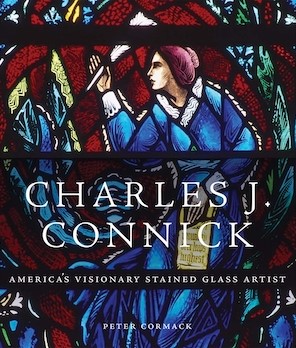
British author and noted scholar of British and American stained-glass Peter Cormack brilliantly recounts the effect of that lone trumpet blast in his recently released book, Charles J. Connick: America’s Visionary Stained Glass Artist. Cormack shines a much-needed light on one of this country’s unsung self-made artists. His sensitively rendered prose propels readers into the drama of Connick’s life and work while complementing an array of exquisite full-color stained glass photographs throughout its pages.
Connick’s is an astonishing ‘rags to riches’ story. As an impoverished child in turn-of-the-century Pittsburgh, he received little formal education and never graduated from high school. Any higher education he received, he gleaned from the bookshelves of Pittsburgh’s Carnegie Library and the cheap seats of local performance venues. Connick’s much-heralded trumpet blast sustained him through times of personal and artistic trial, financial struggle, and years of working as an illustrator for newspapers and streetcar advertisements. If the late 19th and early 20th century was a time of great casting about for Connick, it was also a time of great industrial innovation for the country, leading to, among other things, the development and mass production of opalescent glass used to create ‘glass pictures’ that routinely embellished opera houses, churches, libraries, businesses and private homes of the wealthy.
Connick left illustration work for an apprenticeship in one of Pittsburgh’s opalescent glass workshops, churning out what he later deemed ‘sentimental religious art’ and mawkish pictures – of what he came to call “the awful art glass industry.” Though the milky and subdued opalescent glass conveyed nothing of the luminous vision of glowing light and color begot by the kitchen poppy in Connick’s mind, the practical design and business skills he acquired at the workshops served his ambitions well. Even so, Connick chafed under limits imposed by others’ lack of vision and undiscerning artistry. Cormack’s relief is almost palpable when he recounts Connick’s release from this pedestrian, uninspiring work to travel to Boston and New York where he connects with real artists using transparent colored glass as a more enlightened and sophisticated mode of expression.
But it’s when recounting Connick’s pilgrimage, in 1910, to Europe to experience the stained-glass Medieval masterpieces of ancient cathedrals first-hand that the author practically cheers. If there was ever a time I wanted to crawl into a book and accompany the protagonist on his or her journey through life, it was in Cormack’s pages about Connick’s European pilgrimage. Oh, to be with an artist discovering his or her vision! Connick is, of course, transfixed by all the great cathedrals’ stained glass windows across England, but when he encounters Chartres Cathedral in France, Connick is practically undone. Light streaming through Chartres’ windows, Connick wrote, was “like a new wizardry of sound, a strange music that was also familiar.” What I wouldn’t give to see Connick’s travel journal from that time and place, when he first encountered the world as it existed in his mind’s eye juxtaposed with the world of the real!
During his three-month sojourn, Connick came to understand his artistic medium to a greater and greater degree. He unabashedly claims art to be religious, a higher calling. He sees the stained-glass craft’s “expressive and decorative possibilities rather than means of reproducing pictorial effects.” He is stunned by the play of light through ancient transparent colored glass inset adjacent to or along traceries, transepts and tympanums of English and French Gothic cathedrals and ascribes to it spiritual, transcendent qualities. He hears ancient stained glass windows singing, and likens their visual symmetries to musical harmony. He realizes that art must not be sequestered for a select few but must permeate the very fabric of society, available and accessible for all. “Beauty,” as Cormack so eloquently puts it, “like goodness and truth, is immortal – the three are a great eternal unity,” something Connick embraced in every facet of his life.
Connick returned to the East Coast with his newly discovered insights and began applying them to a variety of stained glass works for both public and private commissions. His growing and glowing reputation eventually allowed him to establish his own stained glass studio in Boston. Trumpeting angels, heraldic shields, Indian chiefs, historic political personages, religious icons, saints, literary figures, folk heroes, forest creatures, flowers – all burst forth in brilliant colored glass to grace a multitude of public and private buildings, universities, hospitals, libraries, churches and cathedrals across the country. For Connick, no subject matter was too pedantic or paltry to be incorporated into stained glass. If it elevated the onlooker’s mind to beauty and enduring spiritual truths, along with perhaps a dash of enchantment, it was worthy of his inclusion.
The soaring stone of New York’s St. John the Divine Cathedral and San Francisco’s Grace Cathedral are two of the better-known sites bestowed with Connick’s windows. However, it could be argued that the lesser-known interfaith Heinz Memorial Chapel in Connick’s native Pittsburgh just may be the pinnacle of his achievement. Like all buildings that boast his work, the Chapel is awash in brilliant hues, tints, saturated jewel-like colors luminous with silvery light – all proclaiming one aspect or another of the development of this country. From Emily Dickinson brandishing a quill pen to Abraham Lincoln surrounded by the words of the Gettysburg Address, important and famous personages are imaginatively represented, rendered with exquisite insight and reflective of historic accuracy. But it’s color, of course, that matters most. Or is it light? Color and Light, not one without the other. A child who entered the Heinz Memorial Chapel not long after the windows had been installed perhaps said it best: “It’s like walking inside a rainbow.”
A true artist is innovative, a visionary who can take old – and even ancient – established ways of doing things and adapt or improve them for a new audience in a new age. As Peter Cormack so deftly conveys in this treasure of a book, Connick was one such artist. If nothing else, this book gives truth to the idea that good books – like Connick’s stained glass windows – serve as portals to other worlds.
B.R. Bodengraven holds a Master of Theological Studies from Weston Jesuit School of Theology in Cambridge, MA (now the School of Theology & Ministry at Boston College, Brighton, MA) and is the author of The Sacred Shed on the Edge of the Ravine, a spiritual memoir of an ordinary life. Bodengraven can be reached at thesacredshed@gmail.com