
by Julie L. Sloan
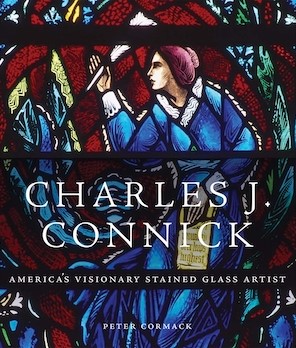
Peter Cormack. Yale university Press, 2024.
Cormack’s book is a thorough and masterful telling of
Connick’s artistic journey and his legacy.
The United States should be deeply mortified that it has taken an Englishman to write the definitive book on one of our most important American stained-glass artists, Charles J. Connick (1875-1945). On the other hand, we could not have asked for a better biographer and interpreter than Peter Cormack. Former
Keeper of the William Morris Gallery in London and for years a historian of the English Arts & Crafts Movement in stained glass (his previous tome for Yale University Press was Arts & Crafts Stained Glass, 2015), Cormack refreshingly lacks the American bias toward our native invention, opalescent glass.
As far as most Americans know, Louis Comfort Tiffany was thebe-all and end-all of American stained glass. All over the country, all styles and kinds of stained glass are referred to as “Tiffany windows,” regardless of aesthetic or when or by whom it was made. Tiffany worked in the medium for about fifty years, directing various studios between about 1880 and 1936, when Tiffany Studios filed for bankruptcy and closed. The signature contribution to stained glass by Tiffany and his competitor John La Farge was the use of opalescent glass, a milky, translucent material that incorporated many colors within a single piece that could suggest mountains, clouds, leaves, or folds of cloth, allowing artists to do away with the glass paint required to delineate details and features on European glass. Called “antique” because it was blown in the medieval manner, European glass was more-or-less transparent and generally of a single color per sheet, needing fired paint to create faces, foliage, and all other detail. American artists of the late nineteenth century felt that English and German painted glass was too dull for the brighter light of this continent. They also consciously eschewed the Medieval style of the European Gothic Revival, which had no history here, adopting a more painterly style influenced by Impressionism and the Hudson River School.
But as with all art movements, a backlash developed against opalescent glass in the early years of the twentieth century, and Connick became one of the most original and prolific designers of the new Modern Gothic movement. Raised and apprenticed in Pittsburgh, Connick moved to Boston where, in 1907, he met the architect Ralph Adams Cram (1863-1942), the foremost advocate of the Modern Gothic style of architecture. Through his voluminous writings and his buildings, Cram promoted Gothic as the only acceptable style for religious, educational, and civic architecture, not just through design but through the medieval philosophy of design. Cram despised opalescent windows in which pictorial scenes, both landscape and figural, had depth and form, looking more like the prospect outside the building than a part of the architecture. Stained glass, he believed, should be flat in aspect and essentially decorative even when depicting figures. Antique glass was the only appropriate material, because it was what medieval artists had used. Paint on the glass was equally suitable for the same reason.
Although he championed other stained-glass artists, Cram found a deeply kindred spirit in Connick. He provided Connick’s first independent commission, the Champlin Memorial at All Saints’ Church in Brookline, MA, in 1909. Cormack writes, “Connick’s G. H. Champlin window was essentially the same in its materials and techniques as European stained glass of the fourteenth and fifteenth centuries, and thus completely different in character from everything he had either designed or worked on throughout the years of his apprenticeship in Pittsburgh and subsequent employment there and in Boston.” It was a revelation to Cram and a relief to Connick that he could now design with “the unique splendor” of antique glass. Connick visited Europe in the wake of this window’s success. A most diligent and keen student of the art, he spent hours in churches and cathedrals, watching how light moved and changed colors, and making hundreds of sketches. Upon his return to Boston in early 1911, Connick opened
his own studio with money from Cram.
Connick’s early style was influenced by medieval windows and the work of Londoner Christopher Whall, who worked with slab glass, blown into a square bottle-shaped mold to make small sheets of deeply colored glass that were much thicker in the center than on the edges. This glass was intense in color and prismatically threw light into rooms in flashes of ruby, cobalt, and a deep fuchsia pink. Connick ordered this glass, called Norman slab in this country, from England, spurning American opalescent glass despite its continuing popularity. In many of his compositions, a silvery white or clear glass formed backgrounds to set off the brilliant tones, invoking grisaille windows of the late Middle Ages.
His designs also incorporated elements of Art Deco as time wore on, spiky forms that contrasted to the graceful, flowing colors and gave punch and emotion to such non-Medieval subjects as Abraham Lincoln and enslaved people, or portraits of American poets like Emily Dickinson. By the end of his life in 1945, Connick had provided stained-glass windows for cathedrals around the country, including St. John the Divine in New York, Grace in San Francisco, and Heinz Chapel in Pittsburgh.
Cormack’s book is a thorough and masterful telling of Connick’s artistic journey and his legacy. With the help of a vast archival collection of business records, journals, and sketches held at the Massachusetts Institute of Technology and the Boston Public Library, the author has penned perhaps the best biography of an American stained-glass artist to date. Voluminously illustrated in full, rich color, Cormack also employs an unusual depth of technical understanding of the craft that further underlines
Connick’s remarkable vision. Not only does this book illumine another chapter in the history of American stained glass, it provides a format upon which all future biographies of American stained-glass artists should rely.
Julie L. Sloan is a stained-glass consultant and historian based in Lake Placid, New
York. She is currently working on the definitive history of stained glass in America.
Her latest book, co-authored with Davida Tenenbaum Deutsche, The Osborne
Apartments, will be published next summer.